
On this page
- How do you know if your agency has outgrown it?
- What does "Notion with AI" mean in 2026?
- What can Notion's MCP server do now?
- Where does Notion with AI work well for an agency?
- Where does it fall short as the place a client's facts live?
- Is anyone using it, and who is behind it?
- The short version
- Can you use both?
- What Storystak doesn't do
- Which should you use?
- Frequently asked questions
- Sources
Facts checked . The products compared here change often; we re-check every 30 days.
The short answer: it is the right setup if you are solo, or a small team where the people asking the AI are the people who know the accounts. Keep it.
It stops being the right setup when any of these is true: more than one person works an account, a freelancer touches client work, or what the AI says about a client ends up in front of that client. At that point you need four things Notion doesn't require of anyone, on any plan: a named person approving a change before everyone's AI reads it, a source on every number, a freelancer's AI limited to their clients, and a report of what the team asked for and couldn't find. You can get close to some of them by hand. Someone then has to keep doing it by hand, for every client, as people and facts change.
Notion is a workspace, built so people can change things quickly. A client's approved facts want a slower path.
Storystak, which publishes this guide, is the other option on this page. It is a client context layer for agencies: one approved AI knowledge base per client, called a Client Stak, that every AI your team uses reads over MCP. Every fact carries its source, and a person approves every change. It isn't an AI assistant and it isn't a workspace, and most agencies that use it keep Notion too.
How do you know if your agency has outgrown it?
Run these five checks on your own workspace. They tell you more than this page can.
- Ask the same question from three accounts. Pick one client and one fact that matters, like the current price of their main offer. Have three people ask their AI, each in their own words. Count the different answers.
- Trace one number. Take a number from a client hub page. Find where it came from and who last confirmed it. Version history shows who typed it. See if anything shows who checked it.
- Connect as a freelancer. If your freelancers are Notion guests, their AI can't read the workspace at all, so find out what they do instead. It is usually a paste into a fresh chat. If they are members, connect as one and ask the AI about a client they don't work on.
- Change a fact through the AI. Tell it to update a client's page. See who was asked first, and who was told afterward.
- Ask for something that isn't there. Ask the AI for a client's position on something the workspace doesn't cover. See whether it says so or writes something plausible, and whether anyone who maintains the workspace finds out.
If all five come back clean, you don't need anything else on this page. If two or more don't, the rest of this page is about why, and what it takes to close each one.
What does "Notion with AI" mean in 2026?
It means your AI reads and writes your Notion workspace directly, through Notion's hosted MCP server. MCP (Model Context Protocol) is the open standard AI tools use to connect to outside sources. Each person signs in once, and from then on the AI can search the workspace, open pages, and create or edit them in the middle of a conversation.
The setup we see most often looks like this:
- a client hub page or database for each client, holding the brief, brand notes, contacts and meeting notes
- call transcripts dropped into a notes database, sometimes summarized by AI on the way in
- an instructions page, or a Notion Skill, telling the AI how the agency likes work done
- Claude, ChatGPT or another AI connected over MCP, so "pull up everything on Fernhill Outdoor" works without pasting anything
(Fernhill Outdoor is a client we made up for this page.)
The idea is sound. As one consultant who runs this setup put it, pasting means the AI knows what you remembered, and connecting means it knows what you wrote down.
Notion published five customer stories about this setup on November 3, 2026: a distributor, a dance studio, a solo writer, a media company and a software firm. None is an agency, and most are one person or one team working on their own business. That is the shape it fits best. An agency has a harder version of the problem, because it keeps this kind of record for every client at once and lets different people into each one.
What can Notion's MCP server do now?
More than most people who set it up a year ago realize. As of November 2026, Notion documents all of this:
- It works on every plan, including Free, and connects to Claude, ChatGPT, Gemini and Cursor.
- Search and read. The AI can search the workspace and open any page or database the connected person can open. On Business and Enterprise with Notion AI, it can also search connected apps such as Slack and Google Drive.
- Write. Create and edit pages, update databases, upload files, add comments.
- Suggest instead of edit. On Business and Enterprise, an AI can propose a change as a suggested edit. Notion says a suggested edit does not change the page until someone accepts it.
- See what changed. The AI can read a page's version history and see whether a change came from a person, from AI, or from an MCP client. History runs 30 days on Plus and 90 on Business.
- Reuse instructions. Notion's Skills (saved instructions) and Custom Agents can be shared across the workspace, and each person gets a private Memories database.
- Request limits. 180 requests a minute per connection on Free and Plus, 600 on Business and Enterprise, plus a limit shared across the workspace. A team asking questions won't notice. A heavy automated job might.
Notion also has verified pages on Business and Enterprise: a badge that says a page is up to date, set until a date you choose, with the page's owner notified when it runs out.
That is a lot, and it is why this setup is worth taking seriously. Notice what the list is made of, though. Each item is something a person can choose to do. None is something the workspace makes sure happened.
Where does Notion with AI work well for an agency?
The page is live. Edit the Fernhill brief at 2 p.m. and anyone asking their AI at 2:01 gets the new version. No files to re-upload, which is the main weakness of files uploaded to an AI project.
Your team is already there. The setup that gets used is the one that doesn't add a step. If briefs, trackers and process docs already live in Notion, the AI reading them is a payoff for work you already did.
It isn't tied to one AI. The same workspace can be read from Claude, ChatGPT or Gemini. If a client tells you to change tools next year, you reconnect rather than rebuild.
It costs nothing extra to try. If you already pay for Notion and an AI plan, connecting them is a sign-in.
If you are a solo operator, or a small team where the people using the AI are the people who know the accounts, stop here and keep what you have.
Where does it fall short as the place a client's facts live?
In the places where a workspace and a record of approved facts want different things. Each of the five checks above maps to one of these.
Can anyone change a client fact?
Yes, if they can edit the page, and so can the AI acting for them. Suggested edits are a real step forward. But the person chooses each time whether to suggest or to edit, and someone in a hurry can still tell the AI to just update the page. Accepting a suggestion takes edit access to the page, with no approver role beyond that.
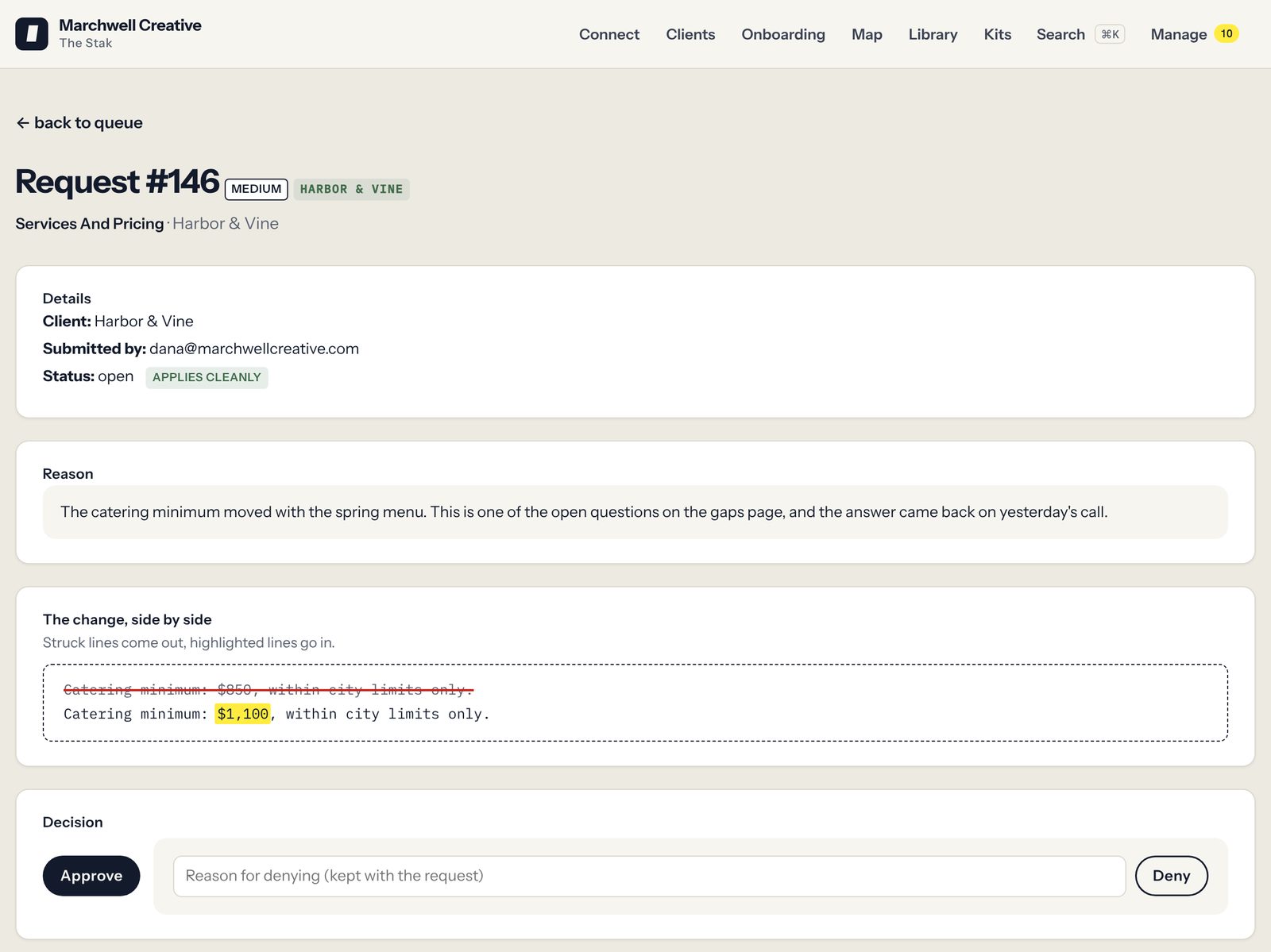
In a Stak nobody edits the record directly. A change is a request: who raised it, what it touches, the reason, and the old and new lines side by side. A person named for that client approves or denies it, and every approval is logged. That is the governance in a Stak. The cost is speed: a change waits for that person, so an agency needs more than one approver per client to cover time off.
Does a number carry its source?
Only if you build it. A Notion page states that Fernhill has 212 dealers. Version history can tell you who typed it and when. It can't tell you where 212 came from or that anyone checked it. You can add a source column to a database and ask people to fill it in, and some careful teams do. Nothing requires it.
A verified badge helps, with two cautions. Anyone with edit access to a page can verify it. And Notion says the badge appears in its own search results and AI citations; Notion's documentation doesn't say whether an outside AI connected over MCP is told a page is verified. We don't know, so ask your AI whether a page is verified and see what comes back before you rely on it.
A Stak keeps numbers as their own records, each with a source attached, and flags any number nobody has confirmed in 120 days.
Can a freelancer get one client and only that client?
This is the hardest one for agencies. Notion says its MCP tools "act with your full Notion permissions," and "can access everything you can access." Permissions flow down the page tree, so a share on a parent page covers everything beneath it. A private teamspace per client (Business plan) is the clean way to separate clients, and it works. It is also a real project to set up and keep right across a full roster, and the AI inherits whatever a member can reach, including anything shared more widely than intended.
Guests are the part most people don't know. Notion states that workspace guests can't connect to Notion MCP at all. A freelancer you added as a guest can open the client's pages by hand, but their AI can't read them. To give them the AI connection, you make them a full member, which is a paid seat with a member's wider default access.
Control over which AI apps may connect, who has connected them, and an audit log sits on the Enterprise plan.
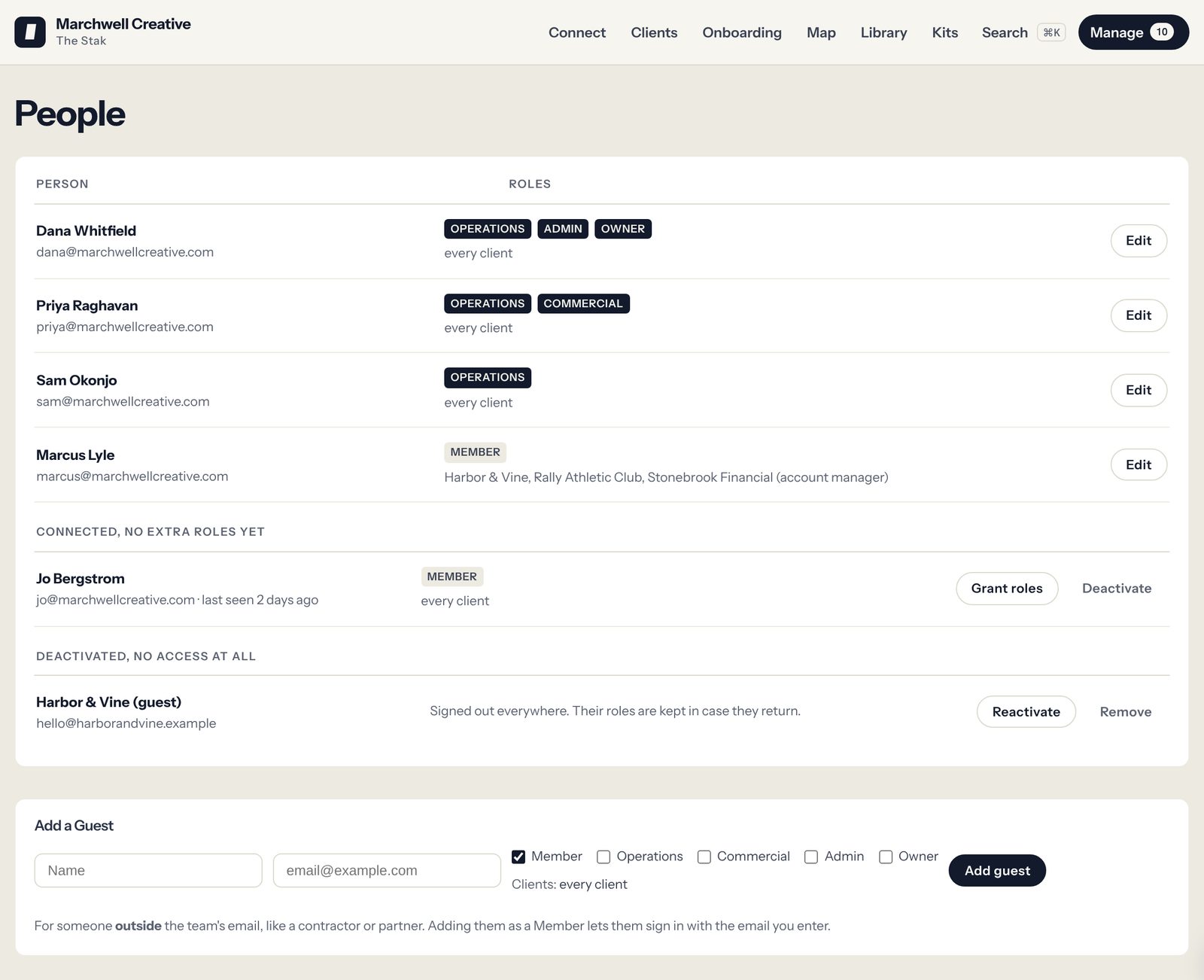
In Storystak every read names one client, and each person is assigned to the clients they work on. A contractor on two accounts reads those two and nothing else, adds nothing to the bill because pricing is per client, and is cut off the moment someone deactivates them.
Does everyone's AI get the same answer?
Often not. In a workspace, what's true about Fernhill is spread across pages of different ages: the current brief, last spring's kickoff notes, a meeting summary. The AI searches and reads what comes back, so two people asking slightly different questions can get different pages and different answers, each delivered with the same confidence.
Notion's memories don't close the gap. They are private to each person, and Notion's own documentation says they "don't replace current source information."
A Stak holds one current version of each fact for a client. Old versions sit in the change history, not next to the live one, so the person writing ad copy and the person writing the monthly report start from the same approved facts.
Can you see what the team asked for and couldn't find?
No. When the AI searches Notion for Fernhill's stance on a competitor and finds nothing, it may say so, or it may write something plausible. Either way nobody who maintains the workspace is told the page was missing. Notion's page analytics show who viewed and edited a page. They don't show which client's knowledge is being used, or what was asked for and not found.
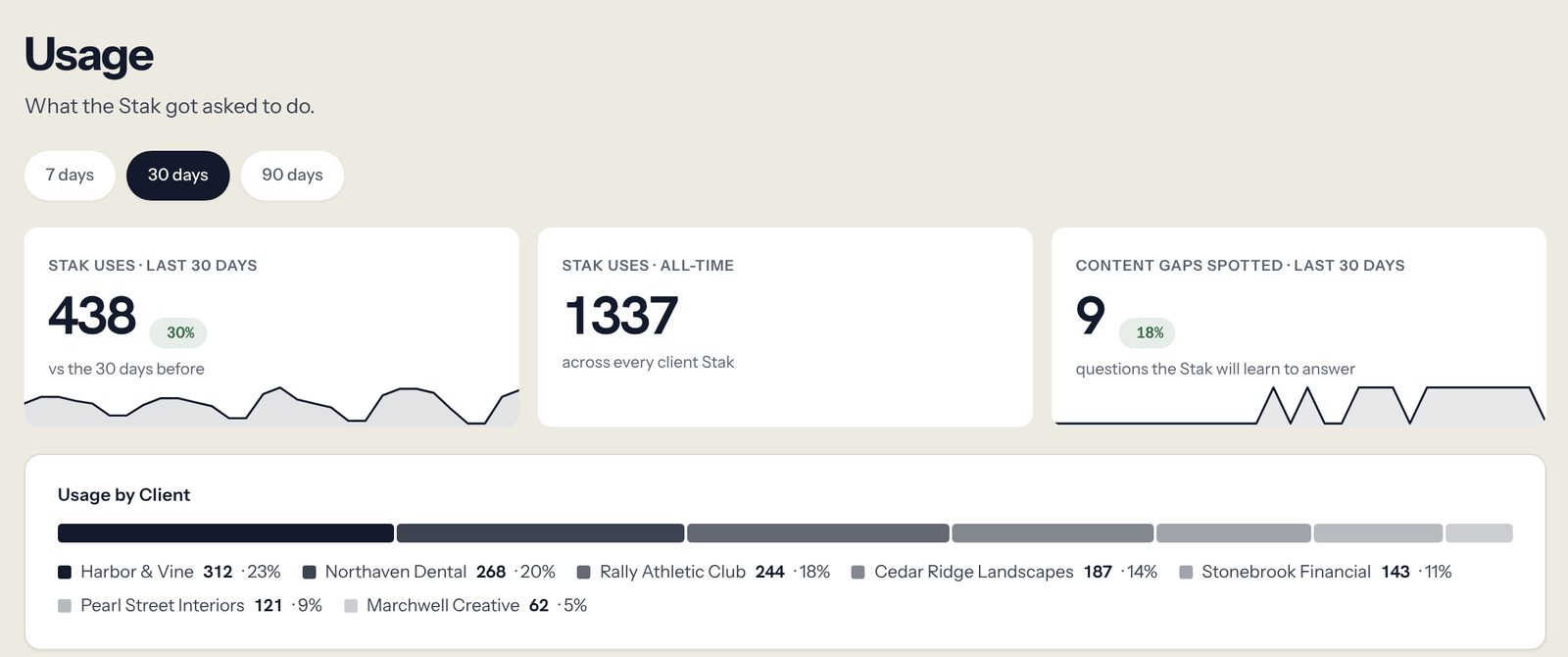
A Stak logs the search that came back empty, and reports activity by client and by person.
What does one wrong fact look like in each?
Take one ordinary week. On Tuesday's call, Marco at Fernhill says the Ridgeline tent goes from $349 to $389 on the first of the month.
In the Notion setup. The transcript lands in the notes database. The client hub page still says $349, because nobody was asked to change it. The following week a freelancer, working from a paste because guests can't connect, drafts the launch ads at $349. Or a member asks the AI, and the search returns the hub page, not the transcript. Either way the ad says $349, and the first person to notice is Marco. Afterward someone fixes the hub page. Nothing in the workspace shows who should have, and the same thing can happen with the next fact.
In a Stak. The account lead, or anyone assigned to Fernhill, files the change from the conversation they are in: old price, new price, the reason, the call as the source. The person named for Fernhill approves it. From then on every AI on the account reads $389, the freelancer's included, and the record shows who changed it, who approved it and why.
The honest limit: someone still has to file that change. A Stak doesn't listen to your calls. What it changes is that there is one place the price lives, anyone on the account can raise the correction, a named person answers for it, and a number nobody has confirmed in 120 days gets flagged.
What does each one cost?
Notion is priced per person and Storystak per active client. They are also not doing the same job, so most agencies that add Storystak keep Notion.
Notion. Business, the plan with suggested edits, verified pages and private teamspaces, is listed at $20 per seat per month. Plus is $10.
Storystak. You pay for each active Client Stak, meaning one that is switched on. There are two ways to pay:
- Month to month: $100 a month for each, plus a $1,500 one-time setup that we are waiving for founding agencies.
- By the year: $75 a month for each, with at least five prepaid at signing ($4,500), setup included and the price locked for 24 months.
Seats are unlimited, contractors included.
Here is a worked example: an agency of 14 people with 18 retained clients and four regular freelancers.
| What it costs | What someone has to keep doing | |
|---|---|---|
| Notion, tightened | 18 seats on Business (the four freelancers become members so their AI can connect): about $360 a month | Build and maintain 18 private teamspaces. Set and renew a verified badge on each hub. Add a source column and get people to fill it. Check what each member can reach. Ask everyone to suggest rather than edit. |
| Notion plus one Stak | Your current Notion bill, plus $100 a month, month to month | File changes as they come up, and approve or deny them, on that one client. |
| Notion plus five Staks | Your current Notion bill, plus $375 a month ($4,500 for the year) | File changes as they come up, and approve or deny them, on those five clients. Approving is a yes or a no on a change someone else wrote up, and there is no limit on changes. Keep one home for each kind of fact. Freelancers on those accounts are assigned in Storystak at no added cost. |
| Notion plus all 18 Staks | Your current Notion bill, plus $1,350 a month by the year | File changes as they come up, and approve or deny them, shared across your account leads. |
The first row is the cheapest in dollars, and it is the right choice if you have a person who will do the right-hand column every week. At most agencies of this size that person is the owner or the most senior account lead, and it is the part of the job that slips first. Even done perfectly, that row still has no required approval, no report of what wasn't found, and no check on whether the source column is true.
The second row is where we'd start. Pick the one account where a wrong fact costs the most: the one with freelancers on it, prices and offers that change, claims a legal team has ruled on, or a client who has asked how you use AI. It is $100 a month with no yearly commitment. You can move to the yearly plan whenever you are ready, and that is when the third row makes sense.
A Client Stak is $75 to $100 a month. Put that next to what that client pays you each month, and next to what it costs when a wrong price reaches their ads or a senior person rewrites a draft built on last year's positioning.
What the price covers, beyond the record: we set up each Client Stak with you, drafted from the files and calls you already have, with a source on every fact, and your team reviews it before it goes live. Then we work through a real task with someone on your team.
Is anyone using it, and who is behind it?
One agency owner's account, in her words. She runs an independent agency with four account managers and 30 to 35 clients. Every client report used to mean checking the facts in it by going back through documents, or by asking her. She "used to dread the first of the month because of reporting." She gave the team one rule: "Before you come to me, ask the Stak first." The next month: "I got no emails, text, or phone calls." By her own estimate in October 2026, a client report went from between 45 minutes and two hours to under 10 minutes.
That is not a Notion story, and it is one agency. But it is the same job the five checks test: checking a client fact before it goes out. Her team used to do it by reading through documents and hoping they had the current one. Now they check against one approved record, which is faster and leaves less room to pick up the wrong version.
Storystak is a new company, founded in 2026 by two people who spent their careers in agencies and marketing teams. You can read who we are on the about page. The agencies that sign on in these first months are founding agencies. They work with us directly, setup is included, the price is locked for 24 months, and they have a say in what we build next. The fine print is on the public price list.
On where client content is stored and who can process it, don't take a summary from us. The security overview, the subprocessor list and the data processing addendum are public. In short: each client's record is walled off from every other client's, nothing is pooled across agencies, and your content isn't used to train AI models. Storystak itself has not been audited or certified, and the security overview says so.
The short version
| Notion + AI over MCP | A Client Stak (Storystak) | |
|---|---|---|
| How a fact changes | Anyone with edit access edits it, or accepts a suggestion | Anyone requests, a named person approves |
| Where a number came from | Whatever the page said | A record with its source attached |
| When it's out of date | Verified badge can expire, if someone set one | Numbers flagged after 120 days; the rest needs a person |
| What the AI reads | Whatever the search returns | One approved record for that client |
| One client only, for a freelancer | A paid member seat, with teamspaces or page permissions kept right by hand; guests can't connect | No added cost, assigned to just their clients |
| Cutting off one person's AI access | Remove the member; central control of AI apps is on Enterprise | Deactivate them on the People page |
| What was asked and not found | Not reported | Empty searches logged |
| Who is using it | Page views and editors | Activity by client and person |
| Works with more than one AI | Yes, over MCP | Yes, over MCP |
| Cost grows with | People ($20 per seat on Business) | Active clients ($100 each, or $75 by the year) |
Can you use both?
Yes, and it is what we'd suggest to an agency that already runs on Notion. Your AI can connect to Notion and a Stak at the same time, because both use MCP.
Keep Notion for the work in motion: project trackers, meeting notes, content calendars, drafts, process docs. Put in the Stak what work gets built on: the client's approved facts, prices and offers, voice, claims the client's legal team has ruled out, who's who, and your agency's own way of working.
Moving a client across is what a Stak is built for. With Claude or ChatGPT connected to both Notion and the Stak, ask it to go through that client's Notion hub. It identifies what is there and copies it into the right places in the Stak as change requests, and a named person approves them. How long it takes depends on how fast your AI model is and how much there is to move. A large record is usually about half an hour for the AI's part, and then the approvals are yours.
The risk with two homes is two copies. Pick one home for each kind of fact. When a client's prices and positioning move into the Stak, take them out of the Notion hub and leave a line saying where they live now. The brief for this month's campaign stays in Notion.
What Storystak doesn't do
It isn't a workspace. There are no trackers, wikis or docs to write in, and it won't replace Notion. If you leave, you can ask for an export of every client's record at no fee.
It isn't an AI assistant. Your team keeps using Claude or whichever AI they prefer. Claude and ChatGPT connect today.
It doesn't watch prose age. Numbers get flagged after 120 days. A paragraph about the client's tone stays as written until someone raises a request.
It doesn't control access file by file. A person assigned to a client can read all of that client's Stak.
It doesn't make AI accurate. Working from approved facts means fewer wrong ones to catch. There will still be some.
And it is slower to change than a Notion page, because a person has to approve.
Which should you use?
Keep Notion with your AI if you are solo or a small team, the people asking the AI are the people who know the accounts, nobody outside the team needs access, and the five checks came back clean. If you are on Notion Business, turn on verified pages with expiry dates for each client hub and ask for suggested edits on those pages.
Add a Stak for the account that matters most if two or more of the checks didn't come back clean. That usually means freelancers or partners on client work, the same account giving different answers depending on who asked, or the upkeep landing on the busiest person at the agency. Start with one client, month to month, and leave Notion exactly where it is. Move to the yearly plan when you are ready.
Put the whole roster on Staks when clients start asking what your AI works from and who checked it. In the WFA's 2026 survey of major brands, 59% had put AI clauses in their agency contracts, and the answer is easier when it is the same for every client. We cover those questions, with the source, in What to tell a client who asks how your agency uses AI.
See it before you decide. Take the demo tour on a fictional agency. When you want to try it on a real account, book a call and we'll build one Stak from what you already have, month to month, and connect it to the AI your team uses.
Frequently asked questions
How do I know if my agency has outgrown Notion with AI?
Run five checks: ask the same client question from three accounts and compare the answers, trace one number to its source, see what a freelancer's AI can reach, change a fact through the AI and see who approved it, and ask for something the workspace doesn't cover. If two or more don't come back clean, the setup needs an approval step, sourced numbers and per-client access that Notion doesn't require on any plan.
Is Notion a good knowledge base for AI tools like Claude and ChatGPT?
For one person or a small team, yes. Notion's hosted MCP server lets an AI search, read and edit the workspace on every Notion plan, and pages are live, so there are no files to re-upload. For a larger agency the limits are approval, sourcing and client separation: anyone with edit access can change a page, facts carry no source, and the AI can reach everything the connected person can reach.
Can a freelancer or guest use Notion MCP?
Not as a guest. Notion states that only workspace members can connect to Notion MCP, and a guest who tries is refused. A freelancer needs a member seat to connect their AI, and then page permissions decide what it can reach.
What are the limits of Notion MCP?
As of November 2026: it acts with the full permissions of whoever connected it; guests can't connect; suggested edits and comment editing need Business or Enterprise; admin control over which AI apps connect needs Enterprise; request limits are 180 a minute per connection on Free and Plus and 600 on Business and Enterprise, with a second limit shared across the workspace. It also has no required approval step and no source attached to a fact.
Can I use Notion and Storystak together?
Yes. Both connect to your AI over MCP and can be on at once. Keep Notion as the workspace and use a Stak for each client's approved facts, with one home for each kind of fact so there are never two copies.
What is a client context layer?
A client context layer sits between what an agency knows about a client and the AI tools its team uses. It is one approved record per client that every AI reads, with a source on each fact and a person approving each change. It does the job of an AI knowledge base, with rules about who can change it and who can read it. Storystak's version is called a Client Stak. A Notion workspace can hold the same information; it doesn't require the approval or the source.
Sources
- Notion MCP, plans and guests: Connect Notion to your AI assistant with MCP
- Notion MCP overview: Connect AI assistants to Notion with MCP
- Permissions and Enterprise controls: Connect AI tools with Notion MCP
- Suggested edits and version history: Work together in Notion
- Search tools: Search and read information
- Skills, Custom Agents and memories: Reuse instructions and delegate work
- Request limits: Notion API request limits
- Verified pages: Wikis and verified pages
- Notion plans: notion.com/pricing
- How teams use it: Five stories of teams getting more done with Notion MCP
- "Pasting means the AI knows what you remembered": How to connect Claude to Notion with MCP, Rob Cressy
- Owner's account and report times: storystak.com, proof. The owner's own estimate, October 2026.
- Storystak legal pages: security overview, subprocessors, DPA, price list

Dan works with agency owners on how their teams use AI day to day, and on what it takes to make that work consistent across people, clients and tools.