On this page
- What is AI slop?
- How has AI slop changed in 2026?
- Do people actually notice AI slop?
- What are the signs of AI slop in writing?
- What are the signs of AI slop in web design?
- Why does every list of AI tells go out of date?
- How do agencies keep slop out of client work?
- Get the two anti-slop skills, free
- Frequently asked questions
- Sources
Facts checked . The products compared here change often; we re-check every 90 days.
Remember Nickelback? "How You Remind Me" hit number one in 2002. By 2010 it had been played more than 1.2 million times on US radio, the most-played song of the decade. People bought it, requested it and sang along. Then, somewhere around the millionth play, hating Nickelback turned into a running joke. The song didn't get worse. We just heard it too many times.
That's the best way I know to explain AI slop trends. We get too much of something we liked, and it turns.
In June, Kyle Chayka described a look taking over the internet in The New Yorker: beige and cream backgrounds, rusty orange accents, big italic serif headlines. He traced it to Claude Design, Anthropic's design tool. A year earlier, that look was how designers got away from the purple gradients AI used to make. Now Anthropic's own prompting guide says its model has "a consistent default house style": warm cream around #F4F1EA, serif display type, italic word accents and a terracotta accent. It's a good look. It just got played a million times.
Slop in 2026 is the default, and the default keeps moving. Here's what counts right now in writing and design, and the two skills we use to keep it out of client work, free at the end. We'll update this guide as the tells move, at least once a year.
What is AI slop?
AI slop is content made with AI that nobody shaped. It reads or looks like the average of everything the model has seen, with nothing specific underneath.
Simon Willison put the word into wide use in May 2024, crediting a post by @deepfates, so he's the usual answer to who coined it. By the end of 2025, Merriam-Webster, Australia's Macquarie Dictionary and the American Dialect Society had all made "slop" or "AI slop" their word of the year. Merriam-Webster's definition: "digital content of low quality that is produced usually in quantity by means of artificial intelligence."
A December 2025 paper, "Why Slop Matters," names its three features: superficial competence, asymmetric effort (seconds to make, real time to read) and mass producibility. Superficial competence is why slop gets sent. It looks fine to the person sending it.
How has AI slop changed in 2026?
It moved into everyday work, the famous tells faded while new ones replaced them, and the platforms started sorting for it.
Into the work. Researchers at BetterUp and the Stanford Social Media Lab named it "workslop" in Harvard Business Review: "AI-generated content that looks good, but lacks substance." In BetterUp's survey of 1,150 US desk workers, 40% had received some in the previous month, and each case took about two hours to sort out. A recap or a landing page that any AI would have written for any client counts, even when every sentence in it is correct.
The tells moved. Wikipedia's running page, "Signs of AI writing," now files the em dash under historical indicators, and says "delve" "dropped off sharply in 2025." The total didn't drop with them. In October, Graphite, a marketing firm, counted 2,548 distinct tells in one current model, Claude Opus 5.5, only 4% fewer than its predecessor, even as its em dashes fell 99%. The old "it's not X, it's Y" contrast survived as "is more than a…", at 98 times the human rate.
The platforms started sorting.
| Platform | What it did | When |
|---|---|---|
| Shows AI-looking posts that lack perspective to fewer people; later added a "seems like AI slop" button and reported a 40% drop in views of content it classed as slop | May to September 2026 | |
| YouTube | Clarified that generic, repetitive or template-based videos can't earn money | July 2026 |
| Spotify | Labels "AI Persona" artist profiles and leaves their music out of recommendations unless you follow the artist | August 2026 |
In October, LinkedIn's editor-in-chief, Dan Roth, told CNN that "your perfectly bulleted list and your hook at the top" aren't what works: "what works is being human." He named two formats and no phrases.
Do people actually notice AI slop?
They notice and they mark it down. They're just bad at saying why, or who made it.
In 1970, the roboticist Masahiro Mori wrote a short essay about robots that look almost human. His example was a prosthetic hand so realistic you can't tell at a glance. Shake it, realize it isn't real, and the feeling turns eerie. That dip in comfort is now called the uncanny valley.
Slop has its own small valley. A page looks right and reads fine, and something feels off before anyone can say what. The reader has just seen that italic serif word on the last forty sites.
The surveys show the cost. In a Gartner survey of 1,539 US consumers, published in March, half said they would rather give their business to brands that don't use generative AI in consumer-facing content. In Clutch's June survey, 55% said they view a brand less favorably once they can tell AI made its creative. Meanwhile, in IAB's January study, 82% of ad executives thought Gen Z and Millennial consumers felt positive about AI ads. 45% of those consumers did.
People still can't reliably spot AI text. In TURING, a 2026 study with 214 judges, they were right about 59% of the time. So the penalty lands on whatever reads as AI, whoever made it. A human-written homepage full of "passionate about delivering exceptional results" gets marked down too. That kind of copy predates AI, which only made it free to produce at any volume.
What are the signs of AI slop in writing?
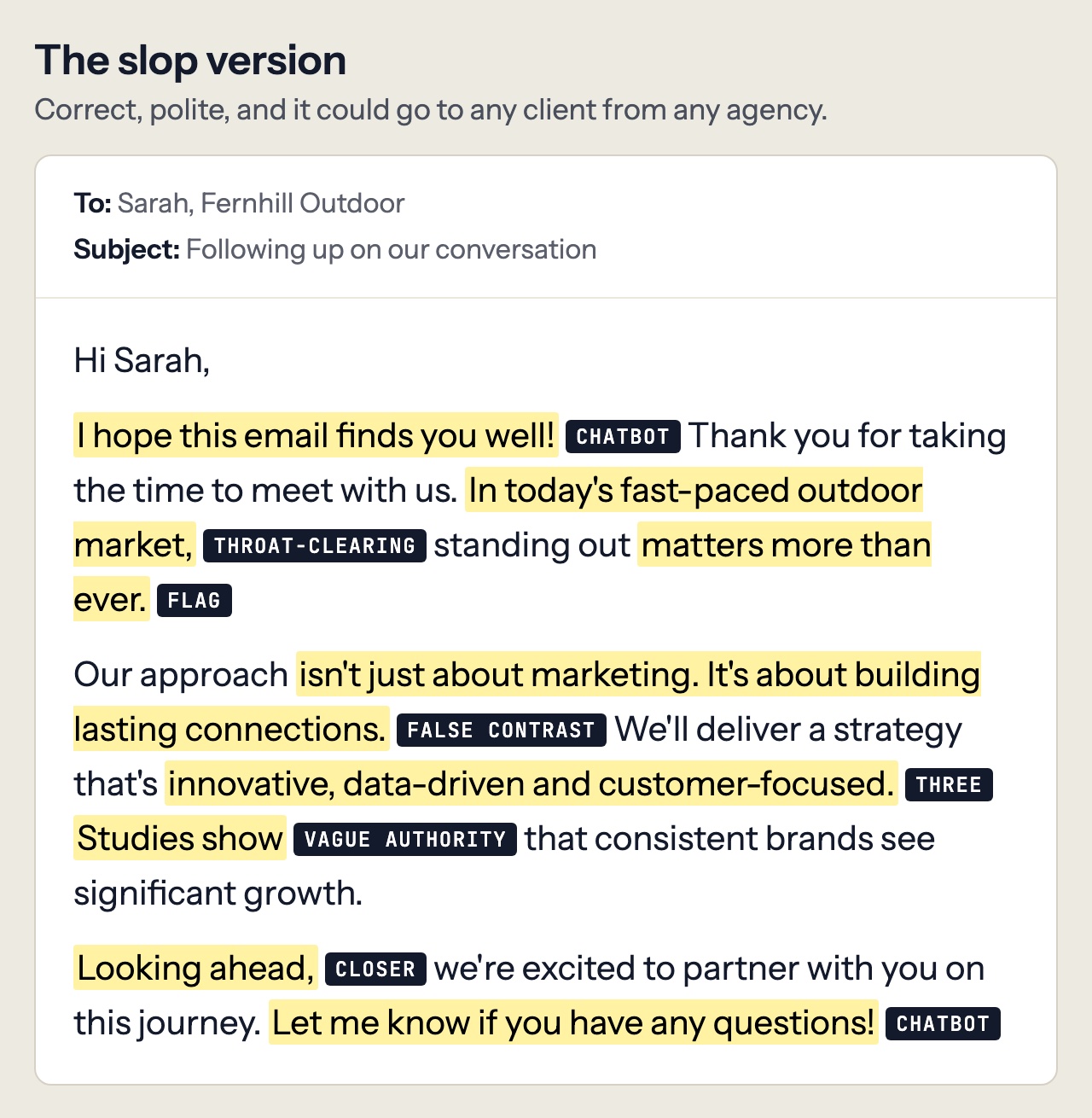
Here's a follow-up email of the kind any AI hands back when it knows nothing about the client, and the same email written with the client's facts in front of it. Switch between the two. Every highlighted line in the slop version is a tell.
The slop version
Written from the client's record
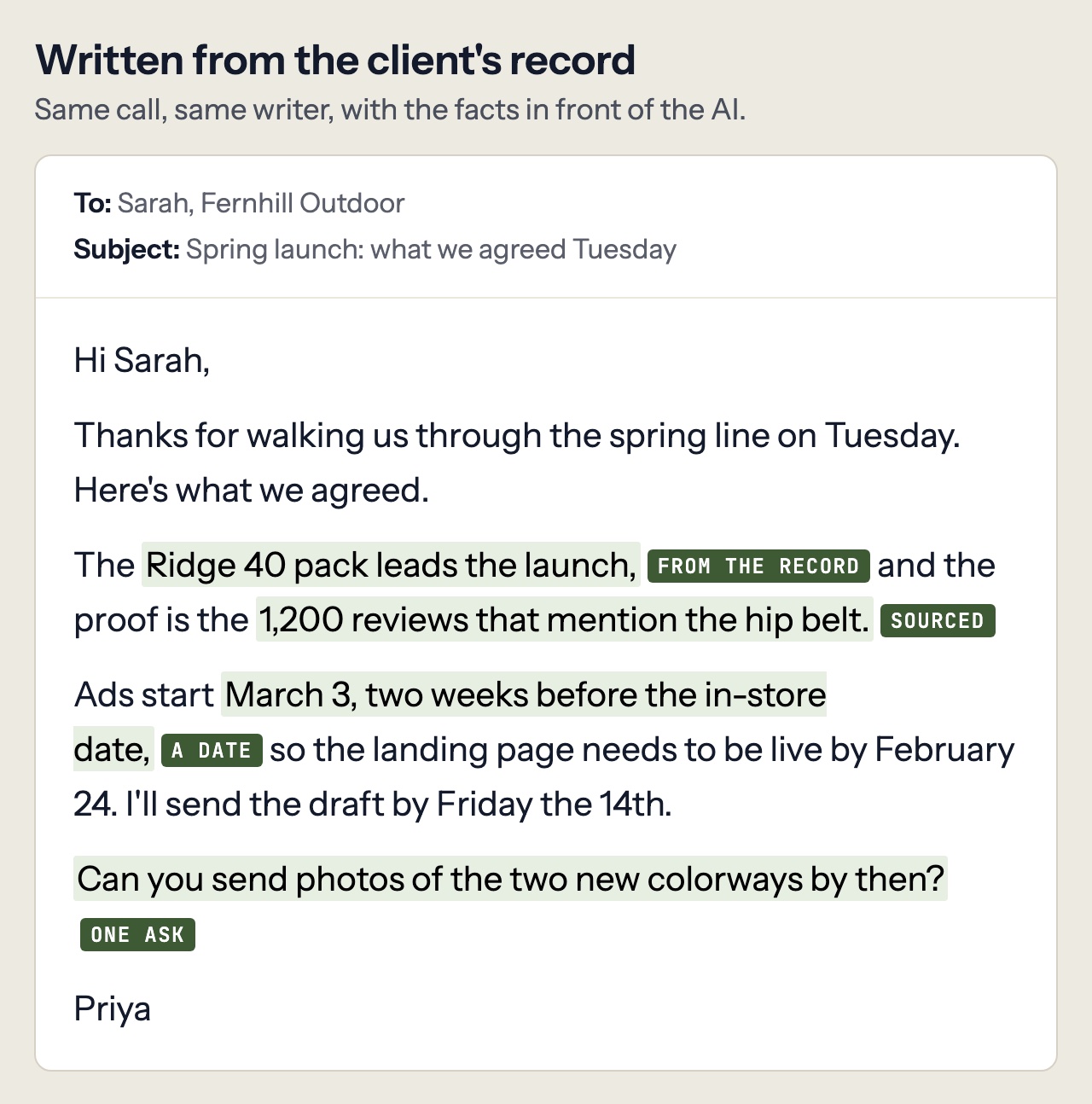
The patterns readers flag in 2026, roughly in order of the damage they do. The first three are substance. Fix those first.
| The tell | What it looks like | Do this instead |
|---|---|---|
| Copy anyone could sign | "We're passionate about delivering exceptional results." | A real turnaround time, a named method, a sourced result |
| Invented specifics | A statistic, quote or client the model made up | Mark the gap and go find the real number |
| Vague authority | "Studies show," "experts agree" | Name the source or drop the claim |
| False contrast | "It's not X, it's Y," "it's more than an X, it's a Y" | Say what the thing is |
| Importance flags | "Why this matters," "here's the thing" | Write the sentence that shows why |
| Reflexive threes | Three adjectives because three sounds finished | The number the content actually has |
| Throat-clearing and summary closers | "In today's fast-paced world," "Looking ahead" | Start with the point; stop when you've made it |
| Chatbot register | "I hope this helps," "Let me know if you have any questions" | Write to the reader, not to the person who prompted the model |
A February Search Engine Land study of more than 1,000 marketing pages found most single tics had little measurable effect on engagement on their own. A "Conclusion" header and "not only… but also" were the clearest exceptions. Phrases are how readers notice. Our bet is that the empty substance is what they leave over, which is why the table starts there.
What are the signs of AI slop in web design?
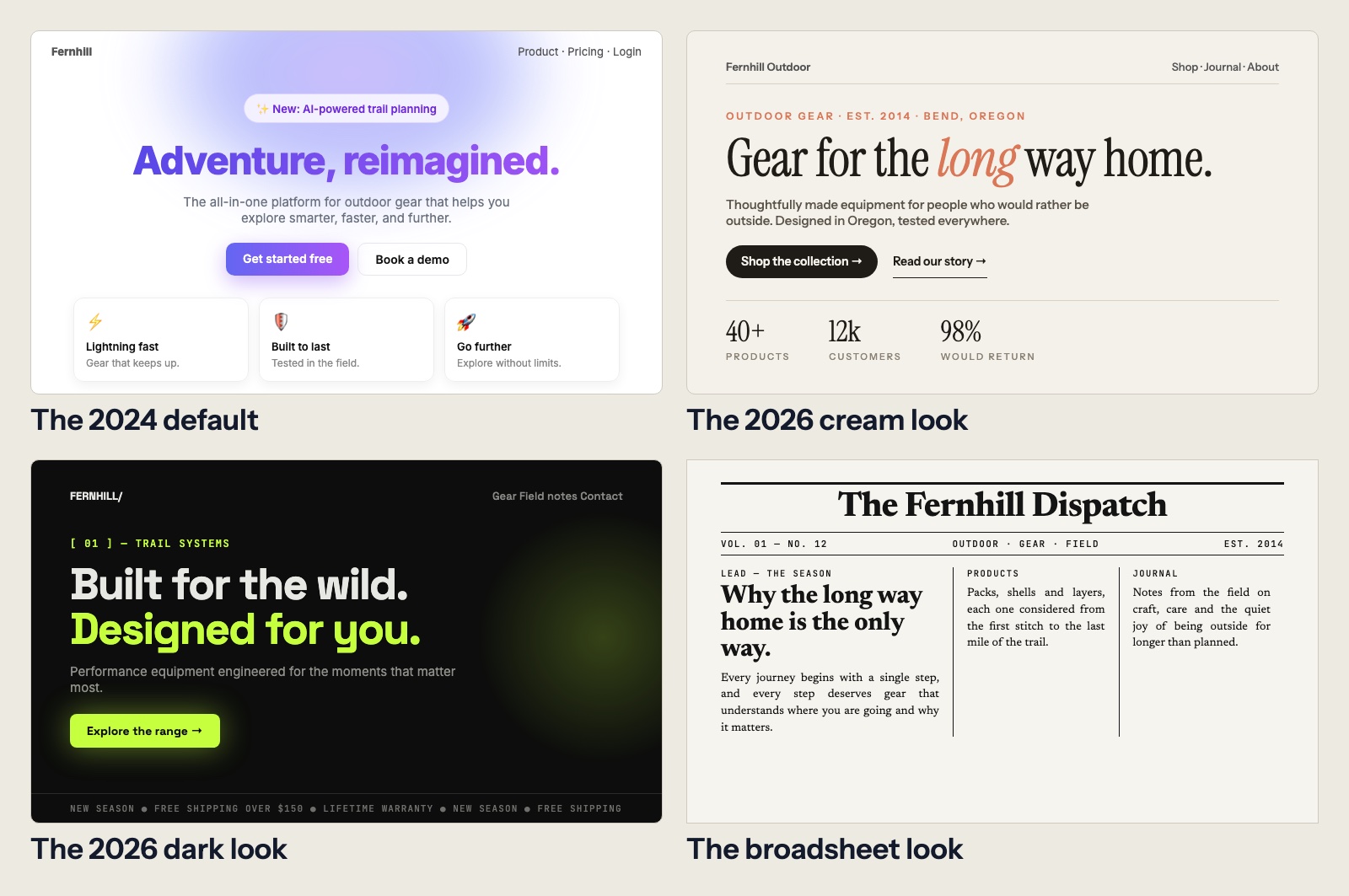
In April, Adrian Krebs scored 1,590 Show HN launch pages against a list of AI design patterns. 54% triggered two or more, and 22% triggered four or more. Here's what the defaults look like for the same made-up outdoor brand.
And the cream one up close. Each number marks a tell.
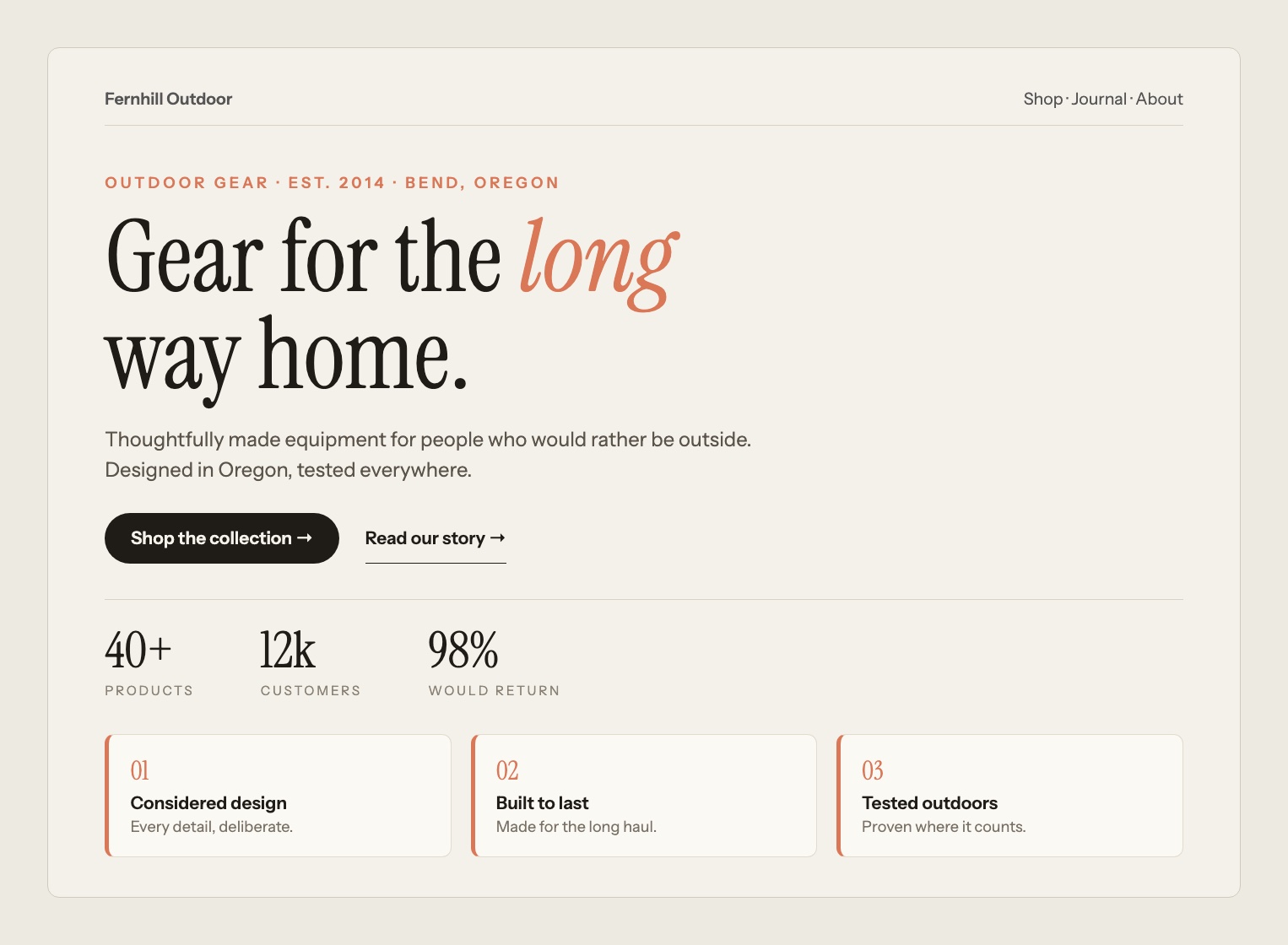 1. A cream ground with a terracotta accent.
2. A label over the heading, in tracked capitals with middle dots.
3. One fancy word, set apart in italic serif and the accent color.
4. A big serif headline, set whole, saying nothing a rival couldn't.
5. An arrow on every button.
6. A row of round-number stats with no source.
7. Cards with a colored left border, still the most reliable tell.
8. "01 / 02 / 03" markers on things that aren't steps.
The other defaults to watch for: the near-black page with one acid-green or vermilion accent; the broadsheet look of hairline rules, square corners and newspaper columns; the 2024 look of purple gradients, Inter and a badge above a centered headline; identical icon cards or an equal bento grid; every section fading in as you scroll; and two-beat taglines like "Build faster. Ship smarter."
Each of these is fine on purpose. A brand that owns cream and serif should use cream and serif. The problem is reaching for one because the brief left the choice open.
That includes us. This site runs on a warm off-white too. We kept it because the brand is paper, and the color is the desk the sheets sit on. Around it there's a sans headline, navy ink and one yellow sheet, with no serif, no terracotta and no italic word. That's the test we'd put to anyone: can you say why it's that color? If warm backgrounds keep spreading until ours reads as a default, we'll change it, the same advice we'd give a client.
Why does every list of AI tells go out of date?
Two forces push it along at once. The first is the Nickelback effect. A tell becomes slop by being everywhere, good or bad. Cream with a serif was a fresh look in 2025. Overplayed, it reads as "made by AI" in 2026, whoever made it.
The second is the models. Anthropic's prompting guide says its house style "is persistent," and that instructions like "don't use cream" "tend to shift the model to a different fixed palette." Forbid purple and you get cream. Forbid cream and you get near-black with one acid accent. Ban "it's not X, it's Y" and you get "it's more than an X, it's a Y."
So every list, ours included, is a snapshot. What lasts is the move each tell makes: a false contrast, an authority nobody named, a look nobody chose. The check we use is a sameness test. If a competitor could put their name on the copy and send it unchanged, or the design would come out of any similar brief, it's a default, whatever it looks like this year.
How do agencies keep slop out of client work?
Give the model something specific to say. Slop is what a model writes when it has nothing else. The fix starts before the first draft, with the client's real material in front of it: the actual turnaround time, the customer's own words from a review, the number and where it came from, the brand's voice and its words to avoid.
That's the problem we built Storystak around. Each client gets a Client Stak, an approved record of their facts, voice and rules, connected to the Claude or ChatGPT plan your team already uses, so your AI starts every draft from that client's material.
You don't need a Stak to use the skills below, though. Real material works wherever it lives, in a brand guide or last week's call notes. You're always the filter. Your output is always your output.
Get the two anti-slop skills, free
Both skills are a free download, the same ones that run in every Stak.
- Anti-slop writing: for anything an AI drafts in words, from emails and recaps to articles, ads and page copy. It gathers the real specifics first, then checks the draft against 12 core tells and 12 families of surface tells.
- Anti-slop design: for anything an AI builds that people look at, from landing pages to dashboards and mockups. It sets a palette, type, a layout idea and one signature element before any code, then checks the build against 19 core tells, the 2026 defaults included.
They work in Claude, Claude Code and any AI tool that takes instructions, with install steps in the download. Both are MIT licensed, and they get updated with this guide.
Download both skills
Add your name and email and the download opens right here. We'll email you when the next edition of this guide and the updated skills are out.
You're on the list. Here are both skills, with install steps inside.
Download the zipAlready have a Stak? You already have these
If your agency has a Stak, skip the download. Both skills are already in your Kits, as the kit called Writing and design that don't read as AI, under Make and always on. Inside a Stak they also read the client's own Stak before the first draft, then check the draft against the tells above before handing it over. The client's voice always comes first.
It's one of thirteen kits included with every Client Stak, grouped the way agencies already think about the work: Run the agency, Plan, Make, Reach and Learn. They make a month of social posts, newsletters, ad copy, landing page copy and review replies, each built only from what that client's Stak knows and handed over ready to approve.
If you don't have a Stak yet, we're taking founding agencies now. Founding agencies get the yearly plan's terms, with setup included and the price locked for 24 months, while founding seats last. Apply as a founding agency. It's two steps and four questions.
Frequently asked questions
What is AI slop?
AI slop is low-quality content made with AI that nobody shaped: it reads or looks like the average of everything a model has seen. Merriam-Webster, which made "slop" its 2025 word of the year, defines it as low-quality digital content "produced usually in quantity by means of artificial intelligence."
Why does AI slop keep changing?
A look or phrase people liked gets used so often it starts to read as machine-made, the way a hit song wears out on the radio. And AI companies tune their models away from the best-known tells, so new defaults take their place.
Why does AI content feel off even when it looks fine?
It's a small version of the uncanny valley, the dip in comfort Masahiro Mori described in 1970 for things that look almost human. Readers catch cues they can't name, like a phrasing they've read a hundred times or a layout they've seen everywhere.
Is all AI-generated content slop?
No. Willison said so in the post that named it. Work built from a client's real facts and checked by someone who knows the subject reads like that brand. Slop could belong to any brand.
What is workslop?
AI-generated work that looks finished but lacks substance, so whoever receives it has to redo it. Researchers at BetterUp and Stanford named it in Harvard Business Review in 2025.
How can you tell if writing was made with AI?
Usually you can't be sure: in a 2026 study, people got it right about 59% of the time. What you can spot is writing that reads as generic, like claims any company could make, unsourced numbers, false contrasts and chatbot phrases.
How can you tell if a website was designed with AI?
Look for the defaults: a cream background with a big serif headline and a rust accent, near-black with one bright accent, an all-caps label over every heading and an arrow on every button. The older purple gradients and Inter still show up too.
Are AI detectors reliable?
A detector score says whether text looks machine-made, not whether it's any good. Wikipedia's editors, who track AI writing closely, advise against relying on them. Fix the substance instead.
Does Google penalize AI-generated content?
Google's spam policy treats "using generative AI tools… to generate many pages without adding value" as scaled content abuse. The target is pages made in bulk with nothing added.
How do agencies avoid publishing AI slop?
Start every draft from the client's real material, check it against the current tells before it ships, and run a fact check on top. Our free anti-slop skills do the gathering and the checking inside the AI tool your team already uses.
Sources
25
- Wikipedia, "How You Remind Me"
- Masahiro Mori, "The Uncanny Valley," translated by Karl F. MacDorman and Norri Kageki, IEEE Spectrum
- Kyle Chayka, "The A.I.-Design Aesthetic That's Taking Over the Internet", The New Yorker, June 24, 2026
- Anthropic, prompting guide: design and frontend defaults
- Anthropic, frontend-design skill, updated September 3, 2026
- Simon Willison, "Slop is the new name for unwanted AI-generated content", May 8, 2024
- PBS NewsHour, Merriam-Webster's word of the year for 2025, December 15, 2025
- Euronews, "AI slop" is the Macquarie Dictionary's word of the year, November 26, 2025
- American Name Society, "slop" is the American Dialect Society's 2025 word of the year, January 2026
- Kommers et al., "Why Slop Matters", arXiv, December 2025
- Harvard Business Review, "AI-Generated 'Workslop' Is Destroying Productivity", September 22, 2025
- BetterUp, workslop research
- Wikipedia, "Signs of AI writing", accessed November 25, 2026
- Graphite, AI tells: the Opus 5.5 update, October 1, 2026
- Search Engine Land, AI writing tics and engagement, February 25, 2026, and PRSA's summary
- LinkedIn, "Keeping conversations real on LinkedIn", May 20, 2026
- CNN, "Even LinkedIn is getting tired of your AI-written posts", as republished by KEYT, October 18, 2026
- TechCrunch, YouTube clarifies its policies on AI slop, July 20, 2026
- TechCrunch, Spotify will label AI persona profiles, August 11, 2026
- Retail Dive, half of consumers prefer brands that don't use generative AI, on Gartner's survey, March 18, 2026
- Clutch, "Human Signals", June 2026
- IAB, "The AI ad gap widens", January 15, 2026
- TURING, LREC 2026, May 2026
- Adrian Krebs, "Scoring Show HN submissions for AI design patterns", April 20, 2026
- Google Search Central, spam policies

Zach spent 16 years building marketing and creative systems before AI existed, and now builds the systems that let an agency's whole team work from the same client knowledge.